
Retail case study
Showcase products without overlighting the store
A reference scenario showing how to combine ambient light, accents and controls in a changing retail space.
Requirement
Make the customer journey intuitive and collections easy to read.
Approach
Layer ambient light, product accents and scheduled scenes.
Verification
Check angles, glare, colours and flexibility.
The context
Merchandising that changes with each collection
Retail lighting must support a changing space. Tables, rails and displays move, while entrances, tills and routes retain their function. Uniform lighting makes products visible but does not establish priorities or rhythm. Excessively strong accents can tire the eye and leave circulation areas unclear.
The brief therefore sets three objectives: maintain comfortable ambient light, guide customers naturally towards merchandise areas, and keep the installation easy to adjust as merchandising changes.
The lighting approach
Build the scene with complementary layers
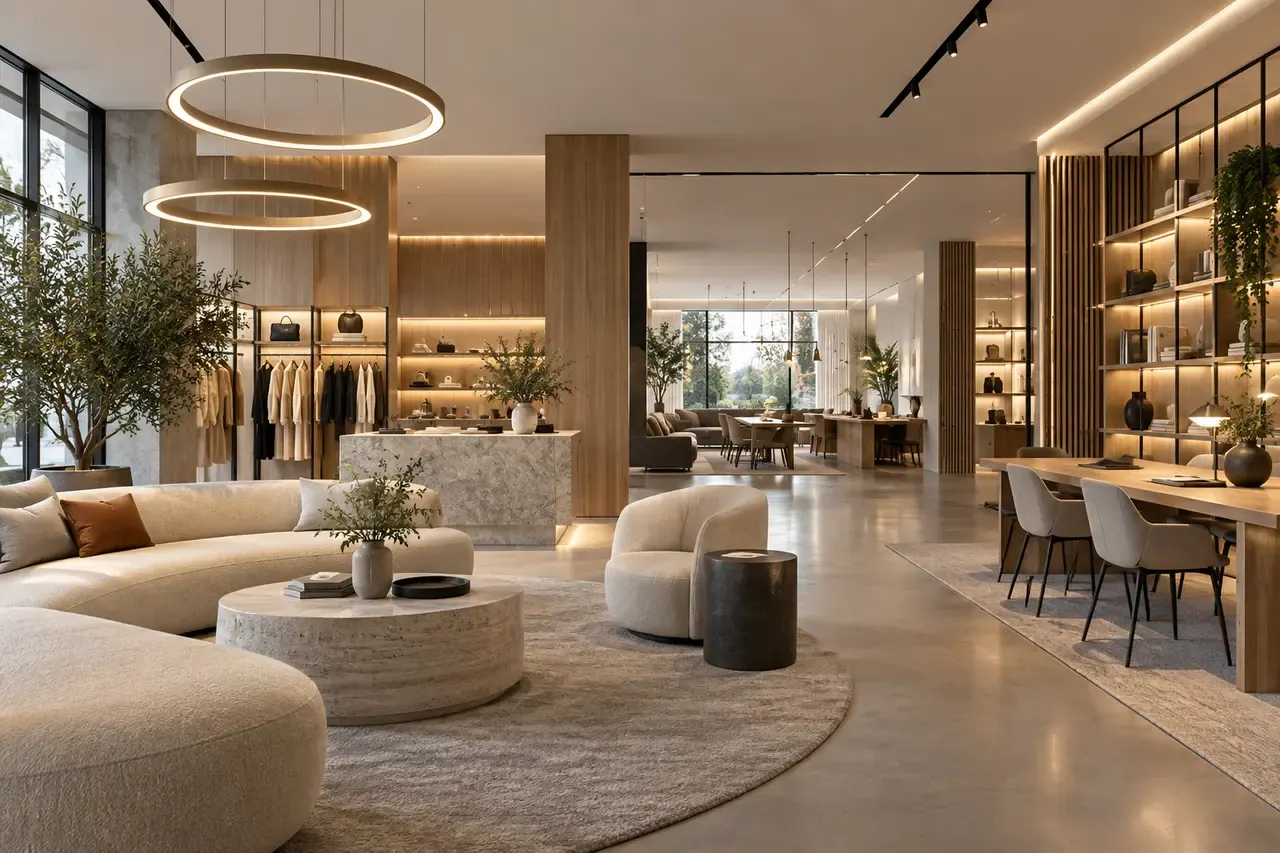
Ambient light connects the customer journey and limits excessive contrast. Adjustable track spotlights add accents to products, walls and seasonal displays. Lighting integrated into furniture helps illuminate shelves without adding visible sources.
Optics depend on projection distances and object sizes. A narrow beam creates a focal point; a wider beam covers a table or clothing rail. Check colour rendering on the actual materials. Scheduled scenes distinguish opening, normal operation, cleaning and window displays after closing.
Key points
Checks that support a retail lighting project
- Show furniture, tracks and promotional areas on the plan.
- Check beam directions from the customer's route.
- Compare colour rendering on the actual products.
- Allow for future furniture and accent changes.
- Programme scenes that staff can operate easily.
- Document references, optics, drivers and settings.
Your retail space
Prepare a selection suited to your project
Share the plan, mounting heights and display areas to help select luminaires and accessories.
Advice and answers
Frequently asked questions: Retail
Essential answers to help you choose and plan your installation.
Why separate ambient and accent lighting?+
Ambient lighting keeps the shop readable and comfortable. Accents prioritise products, new collections and destinations without increasing output everywhere.
How do I choose a spotlight beam angle?+
The angle depends on distance, target size and desired contrast. Several optics can be combined after checking the layout.
What colour rendering is needed in retail?+
Colour rendering should respect the materials and shades on sale. Requirements differ for textiles, food, furniture and cosmetics and should be checked on selected products.
Should a retail installation be easy to reconfigure?+
Where merchandising changes, tracks and adjustable spotlights can make alterations easier. System and accessory compatibility should remain documented.
What information is useful for a study?+
Plans, heights, furniture, display areas, materials, opening hours and atmosphere objectives provide a useful starting point.