
Application
LED lighting for car parks and outdoor spaces
A well-lit car park helps users identify vehicles, obstacles, crossings and building entrances. Design should make the space readable without harsh contrasts or unnecessary light on façades and in the sky. The aim is a clear, durable installation matched to activity levels.
Discuss my project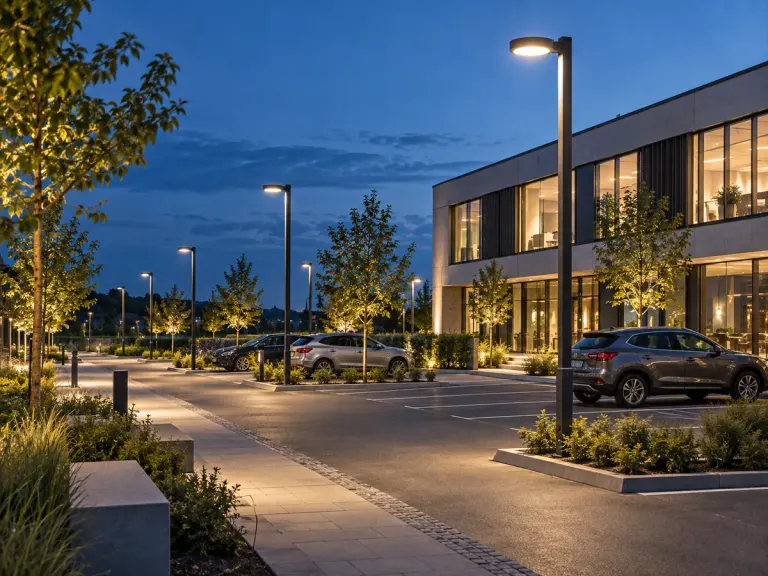
Project requirements
Lighting designed for the way you use the space
Weather, temperature changes, salt exposure and impact risks require attention to enclosures and fixings. Light distribution should cover routes and parking bays while limiting driver glare. Near homes or natural spaces, orientation, colour temperature and schedules also affect neighbours and biodiversity.
Start by identifying traffic routes, crossings, entrances, ramps and waiting areas. Choose wall lights, floodlights, bollards, street lighting or solar solutions according to available mounting points and power. Scheduling, dimming and considered occupancy sensing can match lighting to actual use.
Key checks
Define your requirements
- Traffic plan and conflict points
- Uniformity and glare limitation
- IP/IK ratings, corrosion and wind resistance
- Orientation and light spill control
- Electrical connection or solar autonomy
- Schedules, dimming and detection
Solution ranges
Solutions to consider
- Asymmetric floodlights for open areas and façades
- Street luminaires for roads and car parks
- Bollards and wall lights for pathways
- Solar solutions for areas without mains power
WIXLED support
From requirements to technical selection
Send us the plans, dimensions and main constraints. We can help identify the most relevant product ranges and technical documentation.
Advice and answers
Frequently asked questions: Car parks & outdoor spaces
Essential answers to help you choose and plan your installation.
Which lighting is suitable for an outdoor car park?+
Photometry should match the layout and mounting height. Asymmetric optics can improve coverage and reduce wasted light.
How can light nuisance be reduced?+
Aim luminaires precisely, limit output to actual needs, schedule operating hours and avoid direct light towards the sky or windows.
Is solar lighting suitable for every car park?+
It is suitable when solar exposure, autonomy, night-time use and seasonal conditions are compatible. A site energy study is still needed.
Which IP and IK ratings are useful outdoors?+
Requirements depend on rain, dust, cleaning, public access and impact risks. Evaluate supports and connections alongside the luminaire.
Should a car park run at full brightness all night?+
Not always. Scheduled dimming or zoned detection can maintain orientation and increase light when someone passes.